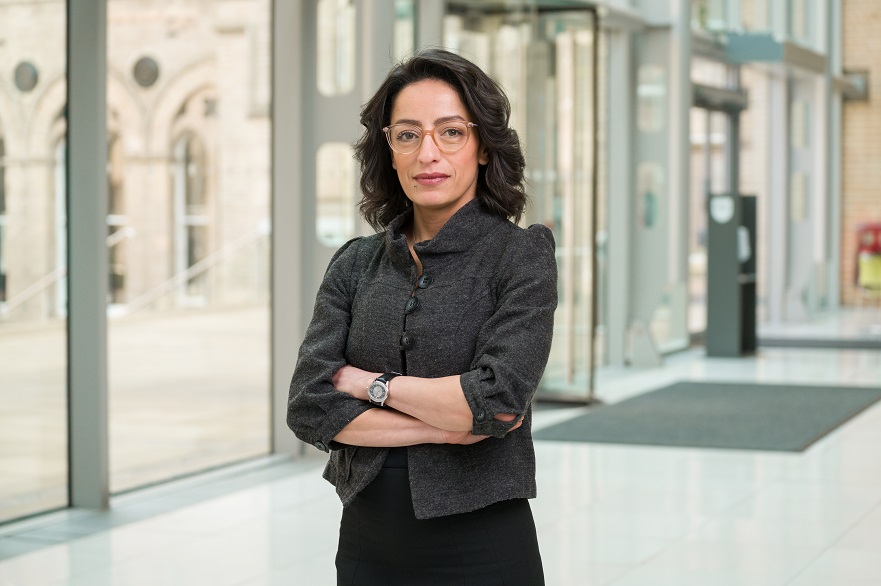


Role
Hind joined Nottingham Trent University in October 2019 and brings extensive teaching experience across Gender Studies, Sociology, and Criminology at both undergraduate and postgraduate levels. She plays a key role in delivering teaching that centres critical and intersectional perspectives on crime, inequality, and social justice. She currently teaches the Year 3 Crime and Inequality module and contributes to postgraduate teaching through the MA Research Project module, supporting students in developing independent, research-led work.
Hind has been actively involved in curriculum development, designing modules such as Gender and Crime and Inequalities and Crime, strengthening the department’s focus on structural inequalities. Alongside her teaching, she supervises undergraduate and postgraduate dissertations and currently supervises four PhD students. She welcomes enquiries from prospective doctoral candidates, particularly in areas related to intersectional feminism, Muslim feminisms, gender and Islam, social justice, black feminist leadership, and transnational activism.
Beyond teaching and supervision, Hind plays a significant leadership role within the university. She is the lead of the Intersectional Social Justice Research Group, a dynamic interdisciplinary space for research on inequality, activism, and social change. She is also the REF representative for Criminology, contributing to research strategy and outputs within the unit.
Hind is a member of the University Shadow Executive Team and is actively engaged in work around decolonising the curriculum, embedding inclusive and critical approaches across teaching and learning. She also contributes to institutional initiatives such as Athena Swan and serves as the Institutes REF coordinator, supporting staff advocacy and engagement.
Career overview
Hind’s career reflects a distinctive intersection of academic excellence, activist leadership, and lived experience, shaping her commitment to research, teaching, and social justice. She has held research and teaching roles across several influential institutions, including the Cynthia Nelson Institute for Gender and Women’s Studies at the American University in Cairo, the Arab Academy for Science and Technology, Strategy Ray, the Ibn Khaldun Centre for Developmental Studies, and the University of Kent in Canterbury, UK. Across these roles, she has contributed to both independent and collaborative research addressing pressing social and political challenges.
Alongside her academic work, Hind has over a decade of sustained engagement in gender-focused social and political activism in Egypt, grounded in both personal and professional commitment. She has been a visible public voice, speaking on televised programmes and contributing to national and international media. Crucially, her activism has contributed to tangible legal and policy change, including successful advocacy around personal status and sexual harassment laws. Her work has consistently bridged grassroots activism, policy engagement, and academic research, positioning her as both a scholar and agent of change.
Her international and cross-sector experience has enabled her to collaborate with academics, activists, and policymakers, leading to the organisation of public engagement events, scholarly publications, postgraduate supervision, and the development of externally funded research projects. Her approach is rooted in participatory and collaborative methodologies, with particular expertise in leading participatory action research that centres marginalised voices.
Prior to her current role, Hind served as an Associate Lecturer at the University of Kent, where she taught across a wide range of sociology and criminology modules, including Sociology of Everyday Life, Fundamentals of Sociology, Introduction to Criminology, Crime & Society, The Criminal Justice System in Britain, and Crime, Media and Culture. She was responsible for designing and delivering seminars, preparing course materials, marking assessments, and supporting undergraduate dissertations.
In Egypt, Hind held several senior research and leadership roles. As Lead Researcher at Strategy Ray, she designed and led quantitative and qualitative research projects across local and regional contexts, managed research delivery, and contributed to publications and stakeholder reports. At the Arab Academy for Science and Technology, she taught sociology and social research methods, while also contributing to curriculum design and departmental development. As Project Manager at the Ibn Khaldun Centre for Developmental Studies, she directed the Egyptian Democracy Support Network, collaborating with academics, activists, and policymakers to produce high-impact reports and organise national and international events. Earlier in her career, as a Field Researcher at the New Woman Foundation in Cairo, she contributed to feminist research initiatives, awareness campaigns, and advocacy programmes addressing women’s rights and social inequality.
Research areas
Hind’s research is situated at the intersection of intersectional feminism, critical criminology, and social justice, with a particular focus on Muslim feminisms, gendered activism, and transnational solidarities. Her work critically interrogates the ways in which gender, race, religion, and power intersect to shape the lived experiences of Muslim women across different socio-political contexts. Moving beyond reductive representations, her research foregrounds the complexity, agency, and political strategies of Muslim feminist subjectivities.
Her earlier work, including her monograph Secular Muslim Feminism (Bloomsbury, 2024) and doctoral research on secular Muslim women activists, examines how women navigate the tensions between faith, secularism, and feminist politics, particularly in contexts marked by Islamophobia, state securitisation, and global conflict. This body of work contributes to emerging scholarship on Muslim feminisms by challenging dominant binaries and rethinking feminist agency in contemporary geopolitical contexts.
Hind’s current research agenda is increasingly focused on building and theorising feminist solidarities across difference. Her British Academy seed-funded project, Intersectional Dialogues, explores how solidarities can be cultivated between faith-based and secular Muslim feminists, addressing longstanding tensions within feminist movements. In parallel, her British Academy/Leverhulme-funded project examines post–Arab Spring feminists in exile, analysing how displacement reshapes activism, identity, and transnational feminist networks. Together, these projects advance new theoretical and empirical insights into feminist collaboration, exile, and resistance.
Methodologically, Hind adopts an interdisciplinary and innovative approach, drawing on participatory action research, narrative methodologies, and critical discourse analysis. Her work is characterised by a strong commitment to collaborative and engaged research practices that centre marginalised voices and connect academic inquiry with activism and policy.
Her broader research interests include decolonising the curriculum, feminist activism in authoritarian contexts, and the study of hidden and unrecognised victims of social harm. Through her leadership of the Intersectional Social Justice Research Group, she continues to foster interdisciplinary collaborations, public engagement, and impactful research that advances debates on inequality and social change.
External activity
Hind is actively engaged in a wide range of external activities that extend her academic work into community impact, public engagement, and policy advocacy. She collaborates with Nottingham Citizens on campaigns such as Racial Equity in Education and Migration Justice, and contributes to initiatives at Nottingham Women’s Centre, where she has supported the development of enhanced peer support for women. She has also served as a Fundraising Advisor for BRAVE Nottingham, helping to support grassroots community projects aimed at advancing social justice.
Hind is a core member of Feminist Dissent, contributing to critical debates on secularism, feminism, and resistance. She is also affiliated with the National Secular Society and continues to engage with national conversations around secularism, rights, and equality. In addition, she is a member of the British Academy Early Career Researcher Network, where she contributes to interdisciplinary dialogue and policy-relevant research discussions.
Beyond these roles, Hind is committed to public scholarship and frequently disseminates her research to wider audiences. She is an author for The Conversation and has contributed to media outlets such as The Independent and Sister-hood Magazine, using these platforms to engage critically with issues of feminism, women’s rights, Islamophobia, and social justice. Through her combined academic, activist, and media work, she continues to shape public debates and foster connections between research, policy, and community action.
Publications
Elhinnawy, H ed. (2026). Shaping UK higher education in the shadow of racial injustice: Decolonising curriculum, pedagogy and practice. London: Palgrave Macmillan. Shaping UK Higher Education in the Shadow of Racial Injustice: Decolonising Curriculum, Pedagogy and Practice | Springer Nature Link
Elhinnawy, H. (2025). Secular Muslim feminism: An alternative voice in the war of ideas. London: Bloomsbury. https://www.bloomsbury.com/uk/secular-muslim-feminism-9780755649341/
Elhinnawy, H.; Kennedy, M.; Gomes, S. (2023). From public to private: The gendered impact of COVID-19 pandemic on work-life balance and work-family balance, Community, Work and Family, https://doi-org.ntu.idm.oclc.org/10.1080/13668803.2023.2265044
Elhinnawy, H (2023). The role of difference in feminist transnational solidarity: secular Muslim feminists in the United Kingdom and France, International Feminist Journal of Politics, https://irep.ntu.ac.uk/id/eprint/49701
Elhinnawy, H., (2022). Decolonising the curriculum: students’ perspectives in criminology, Race Ethnicity and Education, https://doi.org/10.1080/13613324.2022.2154374
Elhinnawy, H., (2022). Surviving British academia in the time of COVID-19: A critical autoethnography of a woman of color. New Horizons in Adult Education and Human Resource Development, 34(3), 54–68. https://doi.org/10.1002/nha3.20364
Elhinnawy, H., (2021). Mothers of intervention: The politics of Motherhood in the battle against ISIS. Reading, ACI, pp. 97 - 103. Available at https://tinyurl.com/ICGR2021 or http://academic-bookshop.com/
Elhinnawy, H. (2019). Contested voices: Secular Muslim women in the Age of ISIS. PhD Thesis. University of Kent. Available at https://kar.kent.ac.uk/82264/
Elhinnawy, H., (2012). Rethinking gender in the new Muslim public sphere: New Egyptian religious satellite television in relation to young female viewers. Saarbrücken: LAP Lambert Academic Publishing. https://my.lap-publishing.com/catalog/details/store/gb/book/978-3-8465-4233-0/rethinking-gender-in-the-new-muslim-public-shpere
Press expertise
The Conversation, March 6th, 2026: Women Without Men: the feminist book that Iran’s regime has failed to silence since the 80s, Women Without Men: the feminist book that Iran’s regime has failed to silence since the 80s
The Conversation, March 7th, 2025: Seven ways feminism has improved the world for young women – compared to our mothers’ generation, https://theconversation.com/seven-ways-feminism-has-improved-the-world-for-young-women-compared-to-our-mothers-generation-251532
NTU Research Podcast; February 2025, Do Afghan women really need saving by the West?, https://www.linkedin.com/posts/ntu-research_nturesearch-ugcPost-7285691737438609409-ZeQm?utm_source=share&utm_medium=member_desktop&rcm=ACoAAAQvM5wBcax7hpnuYkB_L1aHefUV_GYELhY
Interview with Hind Elhinnawy by Eva Stanzl, December 15th, 2024,Warum die Lage für Syriens Frauen schlimmer werden könnte, https://www.wienerzeitung.at/a/warum-die-lage-fuer-syriens-frauen-schlimmer-werden-koennte#infos-und-quellen
The Conversation, November 20th, 2024, How women’s basic rights and freedoms are being eroded all over the world, https://theconversation.com/how-womens-basic-rights-and-freedoms-are-being-eroded-all-over-the-world-243302
The Conversation, November 5th, 2024, Iran: undressing protest shows how women are still fighting even as morality laws get harsher, https://theconversation.com/iran-undressing-protest-shows-how-women-are-still-fighting-even-as-morality-laws-get-harsher-242797
The Conversation, November 9th, 2023, Narges Mohammadi: 2023 Nobel peace laureate on hunger strike after being denied medical treatment over hijab ban https://theconversation.com/narges-mohammadi-2023-nobel-peace-laureate-on-hunger-strike-after-being-denied-medical-treatment-over-hijab-ban-217313
The Conversation, October 6th, 2023, Nobel peace prize: Narges Mohammadi wins on behalf of thousands of Iranian women struggling for human rights https://theconversation.com/nobel-peace-prize-narges-mohammadi-wins-on-behalf-of-thousands-of-iranian-women-struggling-for-human-rights-215190
The Conversation, November 25th, 2022, Afghanistan: after a year of Taliban government, women are more oppressed than ever https://theconversation.com/afghanistan-after-a-year-of-taliban-government-women-are-more-oppressed-than-ever-194553
The Conversation, October 28th, 2021, Afghanistan: the west needs to stop seeing women as in need of ‘saving’ https://theconversation.com/afghanistan-the-west-needs-to-stop-seeing-women-as-in-need-of-saving-170731#comment_2642934
Sisterhood, August 29th, 2018, Being a Feminist in Arab Muslim Society http://sister-hood.com/hind-elhinnawy/feminist-arab-muslim-society/
The Independent, June 17th, 2018, Over a decade ago I made legal history in Egypt. https://www.independent.co.uk/voices/egypt-law-islam-women-sexism-abortion-misogyny-a8403171.html